
Top STEM Courses for Children provide the essential framework needed to transition from being a consumer of technology to a creator of it. By engaging in these programs, young learners develop a foundational understanding of how the world operates, from the software in their tablets to the physics of the buildings around them. These courses serve as a bridge between classroom theory and real-world application, ensuring that education remains an active, exciting journey rather than a series of memorized facts.
Why STEM Education is the Best Investment for Your Child?
Investing in STEM (Science, Technology, Engineering, and Math) is a commitment to developing a child’s ability to think critically and solve problems that do not yet have defined answers. While traditional subjects focus on “what” to know, STEM focuses on “how” to figure things out, which is a skill set that never goes out of style.
- Future-Proofing Careers: Most high-growth industries now require some level of technical literacy.
- Resilience Building: STEM projects often involve trial and error, teaching children that failure is just a step toward a solution.
- Logical Foundations: It reinforces computational thinking, which helps kids organize their thoughts in every aspect of life.

Categorizing the Top STEM Courses for Children: Finding the Right Fit
The most effective way to choose a course is to match the curriculum with your child’s natural curiosities and learning style. Modern STEM education is diverse, ranging from screen-based logic to tactile building projects.
1. Coding & Software Development (The Language of the Future)
Coding is the digital equivalent of literacy in the modern world, allowing children to build everything from simple animations to complex apps.
- Key Platforms: Many programs use Minecraft Education to teach logic within a familiar, fun environment.
- Advanced Topics: Older students can dive into AI and Machine Learning for kids, understanding how algorithms make decisions.
- Outcome: Students move from playing games to understanding the architecture behind them.
2. Robotics & Hardware Engineering (Building the Physical World)
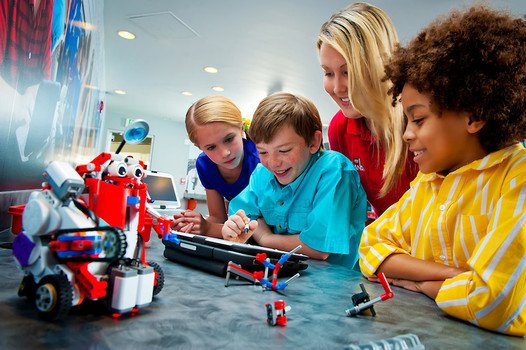
Robotics workshops offer a tangible way to see code come to life, as students build and program physical machines to perform specific tasks.
- Circuit Design: Kids learn how electricity flows and how to connect sensors, motors, and controllers.
- Hands-on Learning: This is ideal for “tactile learners” who need to touch and manipulate objects to understand how they work.
- Analogy: If coding is the “brain,” then robotics and engineering for kids represent the “body” that carries out instructions.
3. Digital Arts & 3D Design (The “A” in STEAM)
By adding “Arts” to the mix, STEAM (Science, Technology, Engineering, Arts, Math) ensures that technical projects are also aesthetically pleasing and user-friendly.
- 3D Modeling: Students use professional software to design objects that can be brought to life via 3D printing.
- Virtual Reality (VR): Teens can explore immersive design, creating 360-degree environments that others can experience.
- Creative Expression: This category is perfect for children who love drawing but want to apply those skills in a modern, technical way.
4. Experimental Science & Math Logic
These courses focus on the “why” behind natural phenomena, using science experiments to prove theories through observation.
- Scientific Method: Children learn to form a hypothesis, test it, and record the results.
- Math in Action: Rather than solving equations on a chalkboard, students see how math determines the strength of a bridge or the speed of a rocket.
Read also about: Teaching Programming to Children
Age-Appropriate STEM Courses: From Early Years to Teens
A child’s cognitive development dictates how they should interact with STEM concepts; what works for a five-year-old would likely bore a teenager.
Ages 5-7: Discovery and Play-Based STEM
At this stage, the goal is to spark curiosity and remove any fear of “difficult” subjects.
- Visual Logic: Using blocks and symbols to move characters on a screen.
- Basic Engineering: Building simple structures to learn about balance and gravity.
- Unplugged Activities: Learning about sequences and patterns through physical games and puzzles.
Ages 8-12: Innovation and Project-Based Learning
This age group is ready to take more ownership over their projects, moving from following instructions to designing their own solutions.
- Intermediate Robotics: Building more complex machines with multiple sensors.
- Game Design: Moving into Minecraft Education or Scratch to build multi-level games.
- Problem-Solving Challenges: Group projects that require collaborative learning and teamwork.
Ages 13+: Advanced Tech and Pre-University Prep
Teens benefit from courses that use professional-grade tools, helping them build a portfolio for university or future internships.
- Text-Based Coding: Transitioning from blocks to languages like Python or C#.
- Professional 3D Modeling: Learning software used in architecture and industrial design.
- Specialized Workshops: Deep dives into AI and Machine Learning for kids or data science.
Online vs. In-Person STEM Courses: Pros and Cons for Parents in Egypt
Choosing between a physical center and a virtual classroom depends largely on your child’s personality and your family’s schedule.
Online STEM Courses:
- Pros: Flexibility in timing, no commute through Cairo traffic, and access to international instructors.
- Cons: Requires strong self-discipline and a reliable internet connection.
In-Person After-school Programs:
- Pros: Direct access to expensive hardware (like 3D printers and robots) and social interaction with peers.
- Cons: Fixed schedules and travel time.
How STEM Courses Boost Academic Performance in School?
STEM education prepares kids for the future and helps them excel in their current school subjects by providing a practical context for what they are learning.
- Math Improvement: When a child uses geometry to design a 3D model, those abstract classroom concepts suddenly make sense.
- Literacy and Communication: Writing code is essentially practicing language structure and syntax, which improves general writing skills.
- Study Habits: The “trial and error” nature of hands-on learning creates a more disciplined approach to all schoolwork.
What to Look for in a Quality STEM Provider (Stemate Tech Standards)
Not all programs are created equal, and a high-quality provider should offer more than just a seat in front of a computer.
- STEM Certification: Look for programs that provide recognized certificates to validate a child’s progress.
- Experienced Mentors: Teachers should be experts in their field who know how to simplify complex ideas for a young audience.
- Updated Curriculum: Technology moves fast; a quality provider like Stemate Tech ensures its tools and languages are always current.
FAQ
What are the most popular STEM courses for children?
Currently, coding (especially using Minecraft Education) and robotics are the most sought-after. These provide the most immediate “fun” factor while teaching great logical skills.
What is the difference between STEM and STEAM?
STEM stands for Science, Technology, Engineering, and Math. STEAM adds the “Arts,” focusing on how design and creativity can be integrated into technical projects to make them more human-centric.
How long does a typical STEM course take?
Most after-school programs run in modules of 8 to 12 weeks. However, given that technology is constantly evolving, many children remain enrolled for several years to progress through the different levels of STEM education.
Give your child a head start in technology and science
Enroll in our STEM Courses for Children today and watch their future unfold!