
Teaching Future Skills to Children ensures that the next generation remains relevant in a landscape where automation and artificial intelligence are redefining traditional career paths. Rather than focusing solely on static knowledge that might become obsolete within a decade, this approach prioritizes “learning how to learn.” By equipping children with the tools to navigate a shifting professional environment, we prepare them to thrive in the 2030 generation and beyond, turning the challenges of technology into opportunities for growth.
Understanding the Concept of Future Skills and Their Vital Importance
Future skills represent a hybrid toolkit of technical proficiency, 21st-century skills, and human-centric capabilities that allow individuals to adapt to any professional environment.
Think of these skills like a high-tech Swiss Army knife. In the past, education provided a single “blade” (a specific trade or degree). Today, children need a multi-tool that includes a “magnifying glass” for critical thinking, a “compass” for digital citizenship, and “strong hinges” representing resilience to handle the pressure of constant change.
- Shifting Paradigms: Careers are moving from lifelong singular roles to multi-stage “portfolio” careers.
- Automation Integration: The focus is moving from competing with machines to mastering human-AI collaboration.
- Global Connectivity: Working in virtual, cross-cultural teams is becoming the standard rather than the exception.
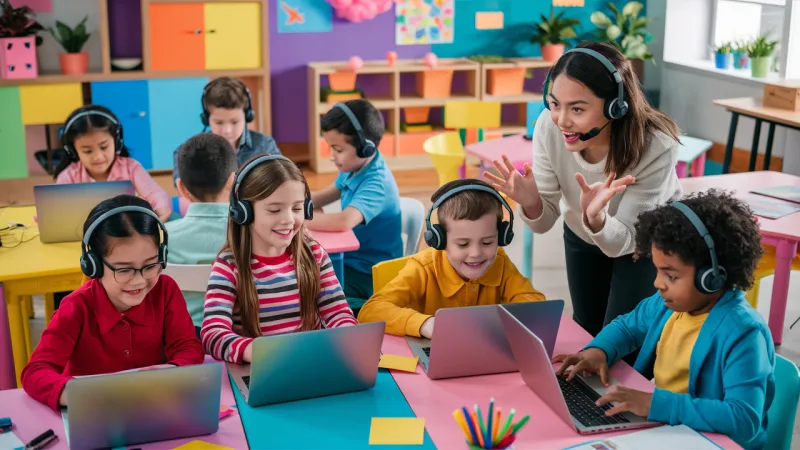
The 4 Essential Pillars of Success for the 2030 Generation
Success in a tech-driven economy relies on four foundational pillars that balance hard technical skills with the nuanced “soft skills” that define human excellence.
1. Digital Literacy & AI Fluency: Navigating a World of Automation
This pillar involves understanding how digital systems function and how to use them ethically to enhance personal productivity. AI literacy is no longer optional; it is the baseline for participating in the modern economy.
- Human-AI Collaboration: Teaching children how to prompt AI tools and interpret their outputs critically.
- Digital Citizenship: Understanding the ethics of online behavior, data privacy, and the long-term impact of a digital footprint.
- Technical Familiarity: Moving from being a “user” of an app to understanding the logic that powers it.
2. Cognitive Skills: Critical Thinking and Complex Problem-Solving
These skills enable a child to evaluate information objectively and design creative solutions to multifaceted challenges. In an era of information overload, the ability to filter noise from signal is a superpower.
- Problem-Solving: Encouraging kids to view every “bug” or “error” as a puzzle to be solved.
- Information Analysis: Learning to question the source, intent, and accuracy of data.
- Strategic Planning: Breaking down a large, intimidating goal into a series of logical, actionable steps.
3. Social-Emotional Intelligence (EQ) in a Tech-Driven World
Emotional intelligence (EQ) remains the one area where humans consistently outperform algorithms, making it a critical asset in the workforce. Even the most advanced AI cannot replicate empathy, cross-cultural understanding, or genuine leadership skills.
- Collaborative Learning: Mastering the art of working in a team, where diverse perspectives lead to better outcomes.
- Self-Regulation: Managing the stress and distractions that come with a hyper-connected world.
- Communication: Articulating complex ideas clearly and persuasively to other human beings.
4. Adaptive Resilience: The Ability to “Unlearn” and “Relearn”
The most valuable skill a child can possess is the mental toughness to “unlearn” an old method when a better one arrives. Adaptive learning requires a mindset that views change as a natural state rather than a threat.
- Resilience: Building the grit to keep trying when a project fails or a new concept feels difficult.
- Curiosity: Maintaining a lifelong desire to explore new fields and technologies.
- Agility: The capacity to pivot between different types of tasks and environments without losing momentum.
Read also about: Digital Education for Kids

STEM vs. STEAM: Why Creativity is the Secret Ingredient
While STEM (Science, Technology, Engineering, and Math) provides the technical framework, STEAM adds “Arts” to ensure that technology serves a human purpose through creative design.
- Innovation over Replication: STEM gives children the tools to build a bridge; the “Arts” in STEAM ask how that bridge can be made more sustainable, beautiful, and user-friendly.
- Visual Literacy: Design thinking helps children visualize abstract concepts, making complex data easier to understand.
- Creative Problem-Solving: Integrating artistic perspectives encourages “outside the box” thinking, which is essential for breakthroughs in engineering and software.
Teaching Future Skills to Children: Practical Strategies for Parents
You don’t need a PhD in computer science to help your child prepare for the future; you simply need to foster an environment of inquiry and experimentation.
- Encourage “Productive Failure”: When your child encounters a mistake in a game or a project, don’t fix it for them. Ask, “What do you think happened, and how can we try it differently?”
- Limit Passive Consumption: Encourage apps and games that require building, coding, or strategizing rather than just watching videos.
- Model Cognitive Flexibility: Show your child how you handle changes at your own work or how you learn a new tool, emphasizing that you are a student for life.
The Global Job Market: Skills That AI Cannot Replace
Despite the rapid advancement of technology, certain human traits remain irreplaceable, and focusing on these ensures long-term career security.
- Ethical Judgment: AI can process data, but it cannot make moral or ethical decisions regarding the impact of that data on a community.
- Interpersonal Leadership: Inspiring a team and managing human dynamics is a uniquely human endeavor.
- Nuanced Creativity: While AI can generate patterns, true “disruptive” innovation, the kind that changes the world, comes from human intuition and life experience.
How Stemate Tech Integrates Future-Proofing into Every Lesson
At Stemate Tech, we don’t just teach code; we teach the mindset required to master any future technology. Our methodology is built on the principle that the software might change, but the logic remains constant.
- Project-Based Pedagogy: Every lesson revolves around solving a real-world problem, reinforcing critical thinking.
- Mentorship over Lecturing: Our instructors guide students through the problem-solving process, encouraging them to find their own path to the solution.
- Holistic Growth: By combining technical training with team-based challenges, we ensure that soft skills and leadership skills are developed alongside coding proficiency.
Empower your kids to innovate, design, and program. Enroll at Stemate Academy today to unlock their analytical potential.
FAQ
What are the top skills children need for the future?
The most critical skills are critical thinking, AI literacy, and adaptive resilience. These allow children to analyze information, work alongside modern technology, and adjust their strategies as the world changes.
How can I teach my child critical thinking?
The best way is to encourage them to ask “why” and “how.” When they see a piece of news or a new game mechanic, discuss the logic behind it and ask them to predict outcomes based on different choices.
How does emotional intelligence (EQ) help in a tech-heavy future?
As technical tasks become automated, “human” roles, such as negotiation, team management, and empathetic design, become more valuable. A high EQ allows a child to lead and collaborate in ways a computer never could.