
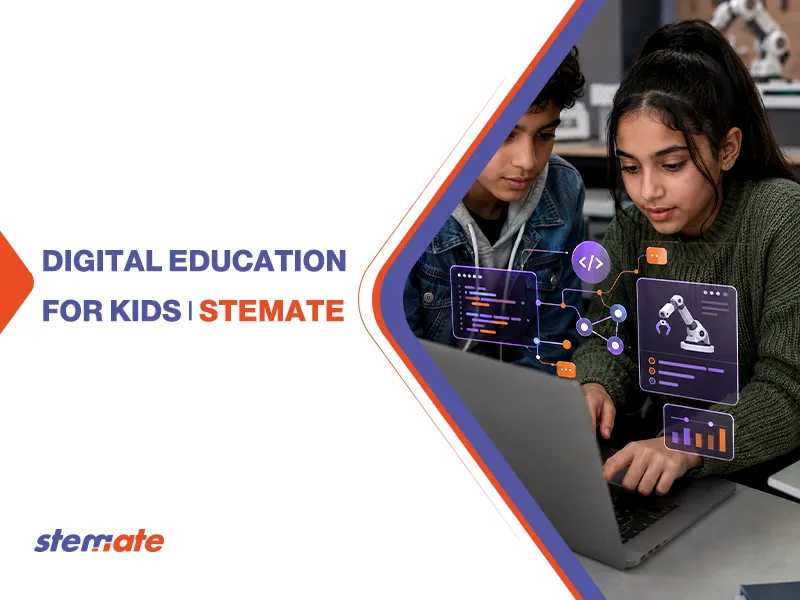
Digital Education for Kids: The Ultimate Guide to Future Skills 2026
Digital Education for Kids redefines how the next generation acquires knowledge, focusing on the technical tools and logical frameworks that drive the modern economy. By integrating programming, data science, and engineering principles directly into the learning process, it ensures children move beyond basic device usage to become creators of the technologies that define our world.
Why Digital Education is Essential for Your Child’s Future
Digital education prepares children for an economic landscape where approximately 85% of jobs that will exist in 2030 have not yet been invented, requiring a high degree of technical adaptability and logical precision. It serves as the primary tool for closing the gap between traditional school curricula and the actual requirements of the 2026 labor market, which demands proficiency in automation, cloud computing, and smart systems.
Key reasons for prioritizing digital fluency:
- Career Resilience: Future professionals must be able to interact with artificial intelligence and automated workflows regardless of their chosen field, from medicine to law.
- Economic Opportunity: Careers in STEM (Science, Technology, Engineering, Mathematics) are growing faster and offering higher entry-level salaries than non-technical roles.
- Scientific Awareness: Technology allows children to simulate physical and chemical reactions, providing a deeper understanding of the natural world through virtual labs and 3D modeling.
- Global Connectivity: Digital platforms expose children to international collaboration, teaching them to work in diverse, remote teams—a standard practice in modern corporate environments.

Key Benefits of STEM and Online AI Learning for Children
STEM and online AI learning provide children with an analytical framework to understand how data and logic interact to produce physical and digital results. These fields encourage students to look beneath the surface of the applications they use daily, fostering a mindset that seeks to understand the “why” and “how” of technological function rather than just the “what.”
Flexibility and Personalized Learning Pace
Digital education platforms allow children to customize their learning journey by moving through complex topics at a speed that matches their individual cognitive processing. This adaptive approach ensures that no child is left behind by a fast-moving class, nor held back by a slow one, allowing for a deeper mastery of subjects like coding and mathematics through repetition and personalized feedback loops.
- Student Autonomy: Children take ownership of their education, choosing when to dive deeper into a specific interest, such as cybersecurity or game design.
- Adaptive Algorithms: Modern platforms analyze a student’s performance and automatically adjust the difficulty level of challenges to maintain an optimal balance of struggle and success.
- Anywhere, Anytime Access: Removing the constraints of a physical classroom means learning can happen in the environment where the child feels most comfortable and focused.
- Reduced Performance Anxiety: Learning in a digital environment allows children to make mistakes privately and correct them without the social pressure of a traditional classroom setting.
Developing 21st-Century Problem-Solving Skills
Engaging with digital challenges requires students to adopt a systematic approach to troubleshooting, where they learn to isolate variables, analyze failure points, and implement iterative improvements. This type of problem-solving is not limited to technical tasks; it builds a mental resilience that helps children tackle complex social, academic, and professional obstacles with a structured and calm mindset.
The stages of digital problem-solving:
- Decomposition: Breaking a large goal, like building a 3D robot, into smaller tasks such as motor calibration and sensor integration.
- Pattern Recognition: Identifying that a solution used for one coding problem can be adapted to solve a different but related challenge.
- Iterative Testing: The habit of trying a solution, observing the result, and refining the approach until the desired outcome is achieved.
- Debugging Logic: Developing the patience to search through a system to find the specific root cause of a failure, a skill essential for high-level engineering and management.
Digital Education for Kids vs. Traditional Education: Why the Switch?
The shift toward digital education is driven by its ability to offer real-time updates and interactive content that keeps pace with technological advancements, unlike traditional models that often rely on static textbooks and passive lecturing. Digital learning transforms the student from a listener into a participant, allowing them to engage with dynamic simulations and collaborative tools that mirror the actual tools used in modern industries.
Comparative Advantages:
| Feature | Traditional Education | Digital Education (2026 Model) |
| :— | :— | :— |
| Content Updates | Textbooks can be years out of date. | Curriculum is updated instantly as tech evolves. |
| Learning Style | Mostly passive (listening/reading). | Active (building/coding/simulating). |
| Personalization | One-size-fits-all instruction. | Individualized paths and adaptive difficulty. |
| Resource Range | Limited to physical library/classroom. | Global access to experts and virtual labs. |
| Feedback Speed | Days or weeks for graded results. | Instant feedback on code and logic exercises. |
Read also about: Teaching Programming to Children

Top Tools and Platforms for Kids’ Digital Education
Successful digital education utilizes a combination of visual programming languages, hardware-software integration kits, and interactive AI platforms to provide a balanced learning experience. These tools are designed to lower the barrier to entry for complex subjects, allowing children as young as six to begin understanding the logic of computer science through intuitive interfaces.
Essential categories of digital tools:
- Block-Based Coding (e.g., Scratch): Teaches the logic of “if-then” statements and loops without the need for complex typing.
- Professional Languages (e.g., Python): Used for teaching students how to write clean, text-based code for data science and AI.
- Robotics Kits (e.g., Arduino, LEGO): Allow children to apply their code to physical machines, teaching them about sensors and mechanics.
- AI Sandboxes: Platforms where children can train their own machine learning models to recognize images, text, or sounds safely.
- Collaborative Platforms: Tools that allow students to code together in real-time, fostering teamwork and communication skills.
How Stemate Tech Academy Empowers Young Minds
Stemate Tech Academy bridges the gap between digital theory and professional skills through a mentored, project-based curriculum that focuses on building functional technology. We provide an environment where children are encouraged to experiment with advanced tools in AI, robotics, and coding, ensuring they gain the confidence to lead in a technology-driven future.
Why Stemate is the choice for future leaders:
- Expert Mentorship: Our instructors are practitioners who understand how to translate high-level engineering into child-friendly concepts.
- Portfolio Building: Every student graduates with a collection of real projects—apps, games, and robots—that demonstrate their technical growth.
- Holistic Development: We focus on technical skills while also nurturing the soft skills of leadership, ethics in tech, and team collaboration.
- State-of-the-Art Labs: Access to the latest hardware and software ensures that students are learning on the same systems used by professionals.
- A Community of Innovators: We connect students with like-minded peers, fostering a network of young creators who inspire each other to reach higher levels of achievement.
Join Stemate’s digital learning revolution now because the future starts today.
FAQs About Digital Education for Kids
At what age should children start digital education?
Children as young as 4–5 years old can begin exploring basic digital learning tools under supervision.
Is digital learning safe for children?
Absolutely, provided they use safe online education platforms designed specifically for kids.
Can digital education replace traditional schooling?
It’s best viewed as a complement, offering flexibility, enrichment, and skill development alongside traditional schooling.
How can parents support digital learning at home?
Create a structured schedule, use trusted child-friendly educational platforms, and encourage exploration and creativity.