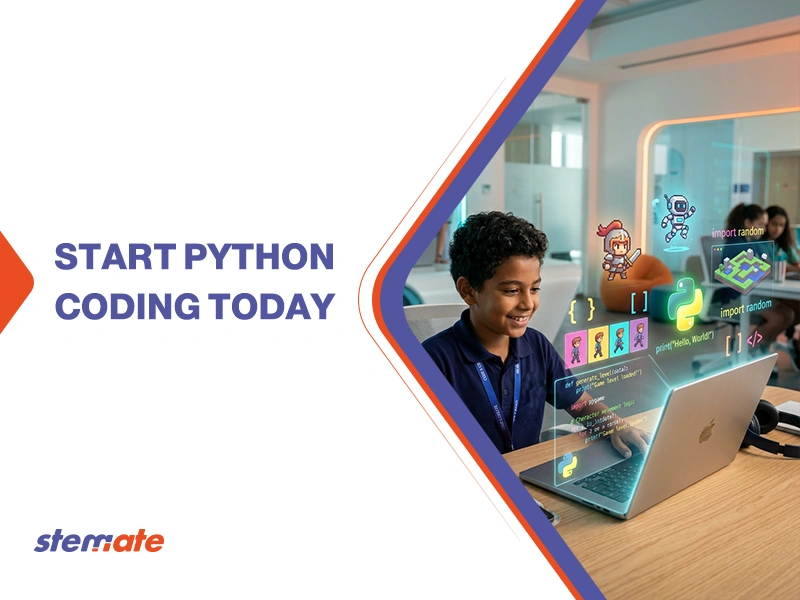
Python for Kids is a text-based programming language that uses simple English commands to tell a computer what to do. It serves as an ideal starting point for young learners because it removes the complicated symbols found in other languages and replaces them with readable words. Learning how to program involves understanding how to give precise instructions to a machine.
For children, this process needs to be engaging and easy to visualize. Python achieves this by having a clean design that looks a lot like a standard written sentence. Instead of worrying about where to put a semicolon or a curly bracket, children can focus on the logic of their program. This makes the transition from visual block coding to actual professional software development much smoother.
Python for Kids: Why is it the Best Programming Language for Kids?
When children start their journey into kids’ coding, they often face a steep learning curve. Many languages require a deep understanding of computer memory or complex syntax rules. Python simplifies these concepts.
Here are several reasons why it stands out for young learners:
Easy-to-Understand Syntax
- No Messy Symbols: Most languages use brackets {} and semicolons to end lines. Python uses whitespace, which makes the code look cleaner and more like a standard paragraph.
- Predictable Rules: Once a child learns a few basic rules, they can guess how other parts of the language work. This predictability builds their problem-solving intuition.
- Brief Code: You can accomplish a task in Python using three lines of code that might take ten lines in a language like Java or C++. This efficiency is very rewarding for young students.
Fun and Interactive Learning
- The Turtle Module: This allows children to control a digital pen to draw shapes. They can see geometry come to life as they program the turtle to move in circles or squares.
- Immediate Error Messages: When a mistake happens, Python tries to explain what went wrong in a way that is easy to fix. This takes the “fear” out of making mistakes.
- Sound and Visuals: With simple add-ons, kids can make their computers beep, play music, or display colorful images, making the experience feel like a creative art project.
Top Python Projects for Kids
When children move beyond basic commands, they need to apply what they have learned. Projects are the best way to do this. By building something tangible, they see the purpose of every line of code. Here are some of the most popular projects for young beginners:
- Mad Libs Generator: A game where the computer asks for nouns, verbs, and adjectives, then plugs them into a story. This teaches children about “strings” and “input.”
- Number Guessing Game: The computer picks a random number, and the child has to guess it. This project introduces logic like “higher” and “lower” using if statements.
- Simple Calculator: Building a tool that adds, subtracts, and multiplies helps kids understand how computers handle mathematical operations.
- Secret Code Maker: Children can write a script that shifts letters of the alphabet to create an encrypted message for their friends.
Build Simple Games
Teaching Programming to Children needs some games; they are excellent teachers. To make a game work, a child must manage several things at once: player movement, score tracking, and the game rules. Using a library called Pygame, children can create sophisticated 2D games. This process involves:
- Logic Building: If the player touches the wall, the game is over. This “if-then” logic is the core of all software.
- Variables: Using a variable to store the “Score” or “Lives” left helps children understand how computers store and update information.
- User Interaction: Programming the computer to react when a child presses a key on the keyboard or clicks the mouse.
- Physics Basics: Learning how to make a character jump or fall simulates basic gravity, connecting coding to science.
Create Fun Animations
Using the Turtle graphics module, children can create fun animations by writing code that controls movement, speed, and color on the screen. This visual approach helps them understand loops and sequences through digital art.
The benefits of animation projects include:
- Visualizing Loops: A child can see that repeating a “turn and move” command 360 times creates a circle.
- Color Theory: Kids can experiment with RGB values to create millions of different colors through code.
- Coordination: Understanding X and Y coordinates becomes much easier when you use them to place an object on a screen.
- Speed Control: Learning how to change the timing of animations introduces the concept of “delays” and “frame rates.”
Who Are These Kids’ Python Courses For?
These courses are designed for children aged 10 to 15 who have an interest in technology, gaming, or problem-solving and want to move from simple visual tools to professional-grade coding. They are also suitable for beginners who have never touched a computer but want to understand how software works. These courses serve several groups:
- Creative Minds: Children who like to tell stories or draw can use Python to build interactive adventures or digital galleries.
- Future Engineers: Students who are curious about how apps like YouTube or Instagram work will find Python to be the perfect introduction to the world of software engineering.
- Problem Solvers: If a child enjoys puzzles and logic games, they will find the challenge of “debugging” code very satisfying.
- Academic Support: As Python is one of the Best Programming Languages for Kids, it helps students who want to get ahead in their school’s computer science or math curriculum.
Book now our Programming Courses for your kids!
FAQ
When to start learning Python?
Most children are ready to start learning Python between the ages of 10 and 12. At this stage, they usually have the typing skills and the logical maturity needed to understand text-based syntax and basic mathematical concepts used in programming.
Can kids learn Python without prior experience?
Yes, children can absolutely learn Python as their first experience with coding. Since Python reads like English, it does not require any previous knowledge of other programming languages or complex computer science theories to get started.
Is Python good for kids to learn?
Python is an excellent choice because it is a “real” language used in professional industries, yet it remains simple enough for a beginner. It builds a strong foundation in logic and problem-solving that helps children in all areas of their education.
Can a 10-year-old kid learn Python?
A 10-year-old can definitely learn Python, especially with the help of visual libraries like Turtle or gamified learning platforms. At this age, children are very good at picking up the “grammar” of a programming language and applying it to creative projects.