
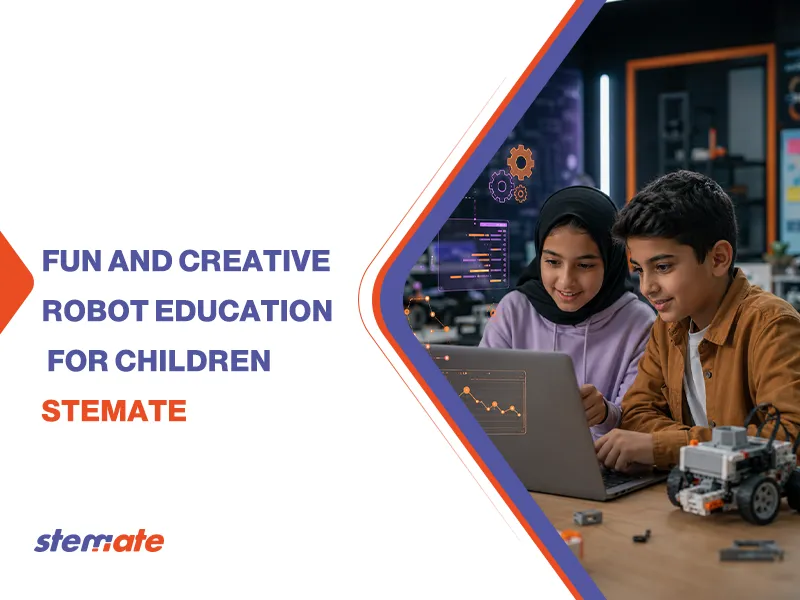
Robot Education for Children establishes a great framework for learning to design, build, and program autonomous machines that interact with the physical world. By uniting computer science, mechanical engineering, and electronics, this specialized field enables young learners to transition from passive technology consumers to active innovators who master the mechanics and logic behind modern automation.
Why Robotics Education is a Game-Changer for Your Child
Robotics education provides a tangible application for theoretical subjects like physics and mathematics, making abstract concepts easier to grasp through direct experimentation. It bridges the gap between digital instructions and physical results, showing children that the code they write has real-world consequences, such as moving a robotic arm or navigating a vehicle through an obstacle course.
Advantages of Early Robotics Exposure:
- Multi-Disciplinary Learning: Children study multiple fields simultaneously, gaining a holistic view of how science and technology integrate to solve problems.
- Preparedness for the 2026 Job Market: As automation expands into healthcare, logistics, and space exploration, early familiarity with robotics gives students a significant competitive advantage.
- Enhanced Spatial Awareness: Building 3D structures helps children understand geometry and the physical properties of materials in a way that 2D screens cannot.
- Scientific Inquiry: The process of building and testing a robot mirrors the scientific method, encouraging children to form hypotheses, conduct tests, and analyze data.
- Motivation through Achievement: Seeing a machine they built from scratch come to life creates a deep sense of accomplishment that fuels further interest in STEM subjects.
5 Essential Skills Developed Through Robot Programming
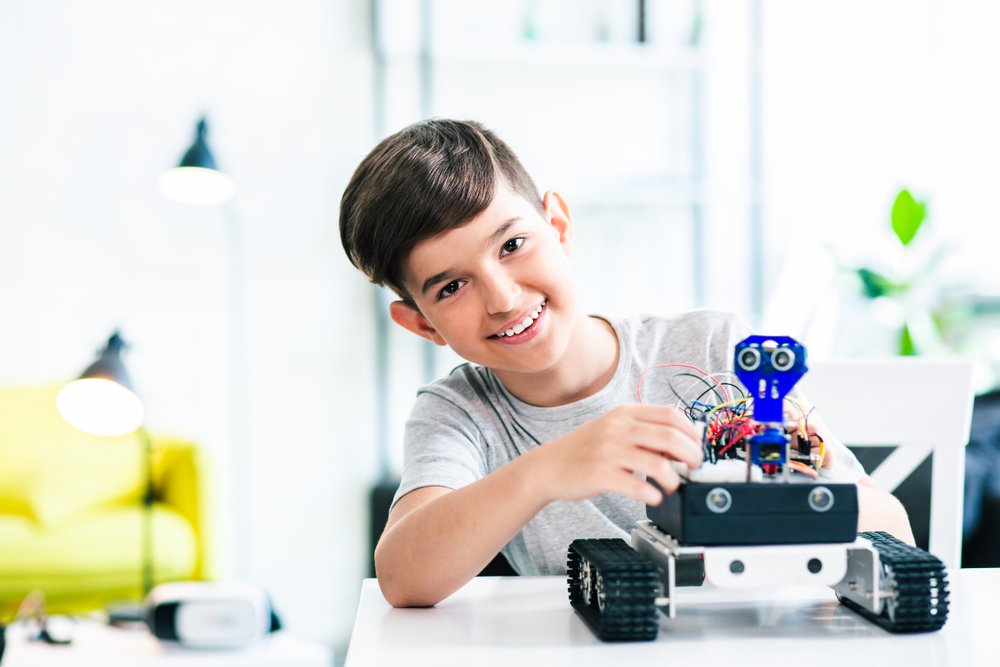
Robot programming develops a child’s ability to think systematically while mastering the technical nuances of hardware-software interaction. Through this process, students acquire a versatile skill set that includes logical analysis, structural engineering, and the resilience needed to troubleshoot complex systems until they function perfectly.
- Logical Analysis: Programming a robot requires a clear understanding of cause and effect, where every line of code must be perfectly placed to achieve the desired physical outcome.
- Structural Mechanical Design: Children learn to build sturdy, efficient machines that can withstand physical forces and perform tasks without breaking.
- Persistence and Resilience: Robotics projects rarely work on the first try; children learn to view failures as data points, refining their work through multiple iterations.
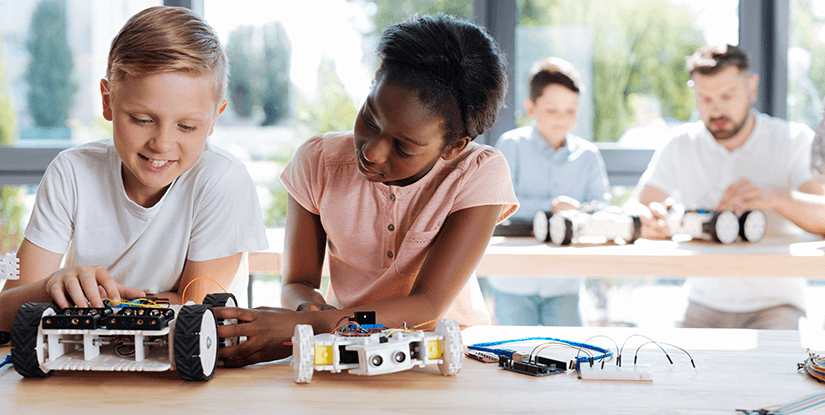
- Collaborative Problem Solving: Students often work in teams to tackle challenges, learning how to communicate technical ideas and integrate different perspectives into a single solution.
- Precision and Accuracy: Robotics teaches the importance of exact measurements and specific commands, as small errors in code or construction can lead to significant functional failures.
Our Robot Education for Children: The Path from LEGO to Arduino
Our curriculum is designed to take students on a progressive journey that begins with visual, block-based mechanical systems and evolves into professional-level electronic prototyping. This path ensures that children first master the fundamental concepts of logic and mechanics using accessible tools before moving on to advanced, industry-standard microcontrollers and text-based programming.
The Educational Progression:
- Foundational Level (LEGO Education): Children use LEGO combined with simple motors and sensors. This stage focuses on building mechanical intuition and using visual blocks to introduce basic programming concepts without the frustration of complex syntax.
- Intermediate Robotics (VEX & mBot): Students transition to more robust metal or plastic structures and start exploring more sophisticated sensors. The logic becomes more complex, introducing data variables and more advanced autonomous behaviors.
- Advanced Prototyping (Arduino & Raspberry Pi): In this stage, students work with real electronic components, breadboards, and text-based languages like C++ or Python. They build custom robots from scratch, learning how to read schematics and write professional code to control various peripherals.
- Specialized Projects: Older students engage in high-level challenges like building drones, smart home systems, or internet-connected robots, applying everything they have learned to create original inventions.
Why Parents Choose Stemate Academy for STEM Learning
Parents select Stemate Academy because we provide a mentored environment where technology is taught through discovery and project-based challenges rather than rote memorization. Our academy ensures that every child receives individualized attention from experts who are skilled in both engineering and pedagogical techniques, creating a safe and inspiring space for technical growth.
The Stemate Advantage:
- Expert Mentorship: Our instructors guide students through the “Aha!” moments of discovery, helping them understand the principles behind the tech.
- Advanced Equipment: We provide access to the latest robotics kits and high-performance computers, ensuring students work with current industry tools.
- Project-Oriented Approach: Every level culminates in a functional project, giving students a sense of ownership and a portfolio of work to show for their efforts.
- Safe and Supportive Environment: We prioritize a culture of curiosity where mistakes are encouraged as part of the learning process, building the child’s confidence.
- Transparent Progress: We provide parents with regular updates on their child’s skill development, highlighting both technical milestones and improvements in soft skills like teamwork and logic.
At Stemate, we bring the magic of robotics to life through interactive, engaging, and highly practical programs tailored for children aged 6 to 15. Start your child’s robotics journey today with Stemate and watch their future take shape! Enroll Now.
FAQs about Robot Education for Children
At what age can my child start robotics?
Children can start as early as 6 years old with simple kits and visual coding.
Does my child need prior coding knowledge?
No, our courses naturally introduce coding through hands-on building activities.
Are the tools provided?
Yes, we use advanced kits like LEGO Mindstorms and Arduino in our workshops.
Where can I attend Stemate robotics classes?
We offer online services and physical locations in Benha and Cairo.
Is robotics education too complex for kids?
Not! Courses like those offered by Stemate are designed to simplify complex ideas and teach them in a fun, accessible way.
What if my child prefers creativity over technology?
Robotics fosters both! Building and programming robots involves creativity, design, storytelling, and innovation, perfect for all interests.