
Developing Children Skills Technology transforms passive screen time into an active learning process that builds cognitive, technical, and social competencies. By engaging with digital tools such as programming and robotics, children learn to navigate the complex requirements of the 2026 labor market while fostering a mindset of innovation and structured inquiry.
Why Technology is Essential for Modern Child Education
Technology serves as a fundamental bridge between theoretical school subjects and their practical application, ensuring students remain competitive in a landscape dominated by automation and data science. It enables a personalized learning experience where children progress at their own pace, exploring complex concepts through interactive simulations that traditional textbooks cannot provide.
Primary reasons for tech integration in education:
- Practical Science Application: Students apply mathematical formulas and physical laws directly to robot movements or game physics, making abstract concepts tangible.
- Market Readiness: Statistics from 2025 and 2026 indicate that over 80% of new professional roles require advanced digital fluency, making early exposure a career necessity.
- Access to Global Knowledge: Digital tools allow children to learn from international experts and participate in global competitions, expanding their horizons beyond the local classroom.
- Interactive Feedback Loops: Unlike traditional homework, coding and digital projects offer instant feedback, allowing children to identify and correct mistakes immediately, which accelerates the learning cycle.
Key Skills Your Child Gains Through Tech Learning
Tech learning equips children with a versatile toolkit ranging from logical analysis and technical proficiency to emotional intelligence and collaborative problem-solving. These skills enable young learners to move from being mere consumers of digital content to becoming creators who can manipulate technology to solve real-world industrial and social challenges.
Core skills acquired through technology:
- Algorithmic Reasoning: The ability to create a set of ordered steps to complete a task, which is the basis for all computational thinking.
- Design Thinking: A user-centered approach to problem-solving that focuses on creating functional and aesthetically pleasing digital solutions.
- Resilience and Troubleshooting: Learning to view “bugs” and errors as puzzles to be solved rather than failures, building significant mental stamina.
- Collaborative Engineering: Working in synchronized digital environments or physical robotics teams to achieve a shared technical goal.
- Information Processing: Developing the capacity to filter, analyze, and utilize large amounts of data to make informed decisions.
- Innovation and Prototyping: The skill of taking an abstract idea and building a working digital or mechanical model to test its viability.
Critical Thinking and Coding Logic
Coding logic forces children to deconstruct large, complex problems into manageable, sequential steps, which is the essence of advanced critical thinking. This process teaches the brain to identify patterns and predict outcomes with high accuracy, a skill set that translates directly into better performance in academic subjects and everyday decision-making.
How coding logic enhances the mind:
- Systematic Decomposition: Breaking down a game level or an app function into individual lines of code helps children handle any complex task in life.
- Predictive Analysis: Children must anticipate how a program will react to different inputs, sharpening their foresight.
- Logical Consistency: Coding requires strict adherence to logic; if one step is out of place, the system fails, teaching the importance of precision.
- Optimization Skills: Beyond just making something work, children learn to find the most efficient way to write code, promoting “lean” thinking.
Digital Literacy and Online Safety
Digital literacy involves understanding the mechanics of the internet, recognizing credible information sources, and maintaining a secure, ethical presence in the virtual world. Online safety focuses on teaching children to identify security threats, protect their data with encryption basics, and engage in responsible digital citizenship to avoid the pitfalls of the open web.
Essential components of digital safety and literacy:
- Data Privacy Awareness: Understanding the value of personal information and how to manage privacy settings across various platforms.
- Source Verification: Developing the skepticism necessary to differentiate between factual data and misinformation or “deepfakes.”
- Cyber Hygiene: Learning the importance of strong passwords, two-factor authentication, and recognizing phishing attempts.
- Ethical Use of AI: Understanding the boundaries of using artificial intelligence for learning while respecting intellectual property and academic integrity.
Read also about: Programming Languages for Kids
How to Use Age-Appropriate Tech Tools for Learning?
Choosing the right technology depends on the child’s age and interests. Here’s how it works across different age groups:
Ages 6-8
Introduce basic logic games, simple coding apps like Scratch Junior, and tech-based creativity activities for early skill development
Ages 9-12
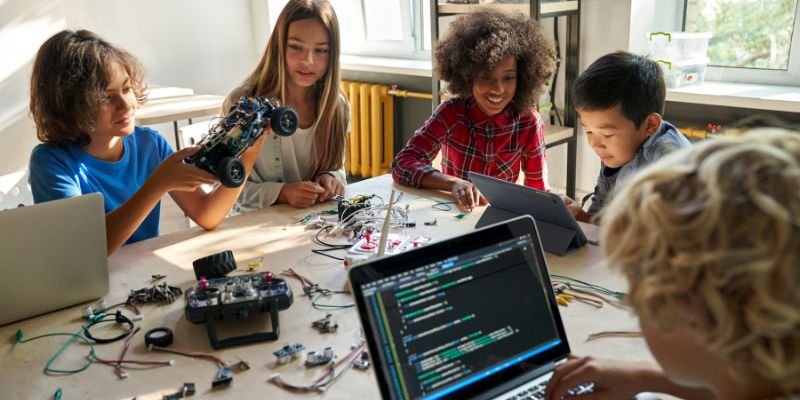
Use intermediate coding platforms (eg, Python basics), robotics kits, and digital innovation for kids to continue Developing Children Skills Technology
Ages 13-15
Use tech workshops to incorporate more complex STEM projects, AI concepts, and problem-solving challenges . Educational technology for future readiness must always be engaging, intuitive, and aligned with the child’s cognitive level

Why Choose Stemate for Your Child’s Tech Journey?
Stemate provides an integrated educational ecosystem that combines international STEM standards with hands-on project-based learning to ensure every child masters future-proof technologies. Our curriculum focuses on transforming natural curiosity into professional-level skills through the guidance of expert mentors and state-of-the-art learning environments designed specifically for young innovators.
The Stemate Advantage:
- Localized Global Content: We offer advanced tech education in simplified Arabic and English, removing language barriers for young learners.
- Hands-on Robotics Kits: Students work with physical components, moving beyond the screen to understand the mechanical world.
- Mentorship Programs: Our instructors are specialists who balance technical expertise with pedagogical skills to support various learning styles.
- Career-Path Tracking: We help parents identify their child’s strengths, whether in AI, software development, or cybersecurity, and provide a clear roadmap for growth.
- Verified Outcomes: Every course ends with a tangible project—a website, an app, or a programmed robot—that serves as a building block for the child’s professional portfolio.
Ready to unleash your child’s potential through this effective method?
Join Stemate’s exciting tech-based courses today and watch them thrive!
FAQ About Developing Children Skills Technology
What are the best tech skills for kids to learn?
Coding, AI, and Digital Literacy are the most essential in 2026.
Is technology safe for early education?
Yes, when using guided platforms like Stemate that focus on active learning.
How can I start my child’s tech journey?
You can start by enrolling them in basic logic and coding workshops tailored for their age.
Is too much screen time harmful for kids?
Balanced and guided use of educational technology promotes learning without harmful effects. The goal is active learning, not passive consumption.
Can young children learn complex topics like coding and AI?
Absolutely! Kids’ coding and AI learning platforms are specially designed to simplify complex topics in a fun and understandable way, making Developing Children Skills Technology achievable even for young learners.
How can parents monitor tech usage effectively?
Setting clear rules, choosing age-appropriate tools, and participating in their learning journey are key to responsibly Developing Children Skills Technology.
Developing Children Skills Technology is crucial in today’s digital age. Technology is not just a tool for entertainment; it has become a powerful ally in education and skill development. But how can we truly harness its potential to nurture young minds? Discover how integrating technology into learning can shape a smarter, more innovative generation.